Setting Up a Simple Watering Schedule That Works
You want a system. Something repeatable, something you can put in your calendar, something that does not require you to think hard about eleven different plants on a Tuesday morning. That is a reasonable thing to want, and you can absolutely have it. You just have to build the system around the right thing.
Schedule the check, not the watering
This is the whole idea, and everything else follows from it. Instead of "water the plants on Saturday," your rule becomes "check the plants on Saturday, and water the ones that need it."
Why the distinction matters: watering intervals are not fixed. Clemson Cooperative Extension notes that there is no universal schedule, because the right frequency depends on the plant species, its growth stage, its location, the type and size of its pot, the soil mix, and the weather. Any of those can change without you noticing.
A check-in schedule gives you the reliability of a routine without the rigidity that drowns plants. University of Missouri Extension puts the underlying rule simply: never water any plant unless it needs it. Your weekly walk-around is just how you find out.
The check itself is fast. Push a finger two inches into the mix, or lift the pot and judge the weight. Ten plants take about two minutes.
Group plants by need
Making eleven separate decisions is exhausting. Making three is easy. Sort your plants into rough categories and place them together physically, which also groups them by the light they want.
- Dry lovers. Succulents, cacti, snake plants, ZZ plants. Let the mix dry out completely, then water thoroughly. Often two to four weeks apart.
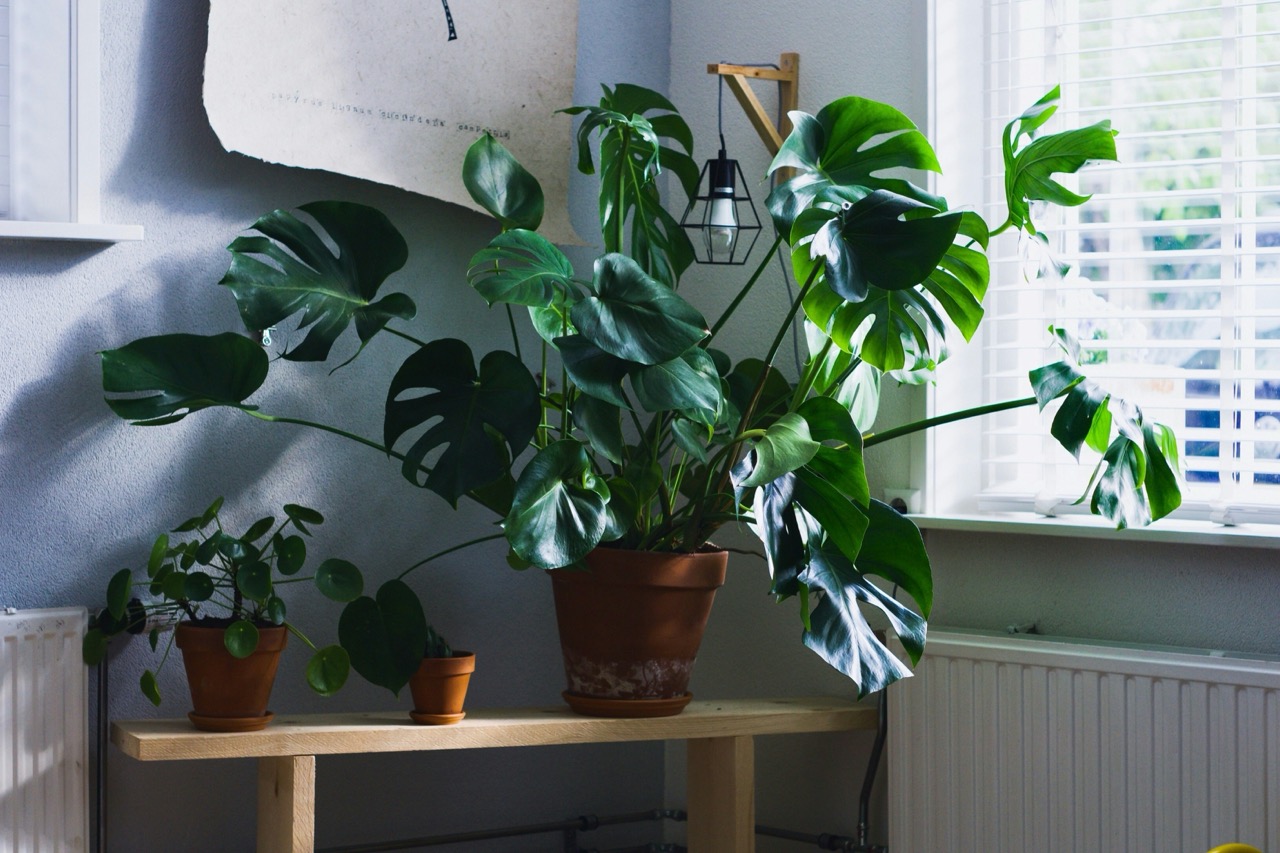
- Middle ground. Pothos, philodendrons, monsteras, rubber plants, dracaenas, spider plants. Water when the top inch or two is dry.
- Moisture lovers. Ferns, calatheas, peace lilies, prayer plants, most palms. Keep evenly moist but never soggy. Water when the surface is just barely dry.
Now your Saturday check has structure. Skip most of the dry group most weeks, glance at the middle group, and expect the moisture lovers to need attention. A peace lily is a helpful bellwether, since it droops dramatically and recovers quickly, and if it is thirsty the rest of that group probably is too.
Tools worth using
Your finger is still the best tool. Free, accurate, always available, and it tells you soil texture and temperature at the same time.
A wooden chopstick or skewer works like a cake tester for deep or large pots. Push it in, wait a moment, pull it out. Damp soil clings; dry soil does not.
Moisture meters are popular and worth a caveat. The cheap probe types respond to dissolved salts as much as water, so readings drift with fertilizer and mineral content, and they can read "moist" in soil that has pulled away from the probe. Use one as a rough second opinion, not a verdict.
A phone reminder is the most useful tool of all, but set it to remind you to check, not to water. Plant care apps are fine for the same reason: treat their notifications as prompts to look, never as instructions to pour.
A watering can with a long spout lets you get under foliage and water the soil rather than the leaves, which keeps foliage dry and reduces disease risk.
Adjust for the seasons
Your routine should shift twice a year. In winter, days are short and most houseplants slow down considerably. Illinois Extension describes plants as coasting through winter, not growing much and unable to use water as efficiently, which means you will be watering less often and should keep the soil on the drier side while still preventing wilting.
In spring and summer, the opposite happens. Longer days, active growth, and warmer air can double how fast a pot dries out. If your check has been weekly, move it to twice weekly from late spring through summer.
The advantage of a check-in habit is that you do not have to calculate any of this. The soil tells you, and your job is just to keep showing up to ask.
A sample weekly routine
Saturday morning, about ten minutes. Start with the moisture lovers and work toward the dry group. Feel each pot. Water the ones that are ready, thoroughly, until it runs from the drainage holes, then empty the saucers ten minutes later. Glance at leaf undersides while you go. Once a month, add a leaf wipe and a quarter turn for even growth.
That is the entire system. One recurring slot, three groups, and a finger.
Shopping for plants this weekend?
Our directory lists plant nurseries and garden centers across the US with each one's address, phone, and website, so you can buy from real local growers.
Find a nursery near you